Happy Birthday Susanna Wesley! By Amber Schamel

Susanna Wesley is of one of the most inspirational women in history. So in honor of her birthday today, I thought I would share what makes her so inspirational to me.SW
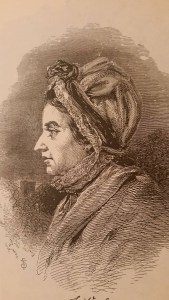
Susanna Annesley was born on January 20, 1669. She was the 25th of 25 children born to Dr. Samuel Annesley and Mary (White) Annesley. Susanna had strong religious convictions from a very young age. At 13, she stopped attending church where her father was a dissenter and began attending the official Church of England.

At age 19, Susanna married Samuel Wesley. Little did she know that her life would hold many hardships. Susanna bore 19 children, including two sets of twins, however nine of those children –including the twins—died as infants. One of her children was accidentally smothered by her maid.

Susanna educated her children at home. The day after their 5th birthday, she taught them the alphabet. They were expected to learn it all on that day, and all but two did. The children schooled for 6 hours each day, and they all received a good education, including her daughters.

Mr. Samuel Wesley had little ability when it came to finances and he was thrown into debtor’s prison twice. His lack in this area created constant struggle for Susanna, and she became very efficient with what she did have.
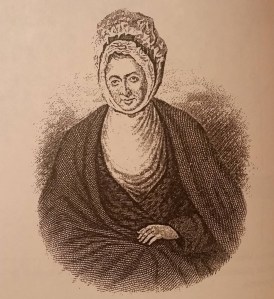
WestleyThe Wesley’s house was burned—twice. During the first fire, her son John Wesley was nearly burned alive, but God had a plan for him and he was saved through a second story window.

One of my most prized books is an out-of-print copy of The Complete Writings of Susanna Wesley. There are letters cataloged there where Susanna is asking for advice in regards to a situation with her husband. During their evening prayers, Samuel ended with “God save the king.” It was expected that Susanna should repeat the saying, however she did not because she felt that the king occupying the throne at the time was not the rightful heir. Because of her defiance, Samuel left. He was gone for over a year, and apparently refused to share a bed with her for a time even after his return.

With so many hardships, it is no wonder that Susanna sometimes had her moments of utter desperation. Susanna was known to plop down in the middle of the kitchen and throw her apron over her head. Her children knew that when mommy did that, she was praying, and no one was to bother her.

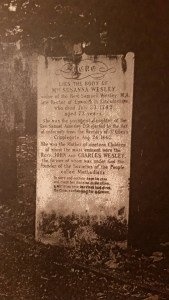
Susanna was a devout woman of God, and she impressed that into her children as well. Her sons John and Charles both became great leaders of the Methodist movement, which earned Susanna the title “Mother of Methodism”. Charles wrote over 6,000 hymns and John became one of the greatest clergymen of his time. John held his mother in such high esteem that, at age 7, he determined never to marry “because I could never find such a woman as my father Grave of SWhad.” John did marry, but not until about 40 years later, after his mother’s death.
The most amazing thing about Susanna, is that even through all her hardships, she placed her trust in God, and never faltered. She lived a life of service to the Almighty, and accomplished many things for His glory.

At the age of 73, Susanna Wesley died on July 23, 1742. She was buried at Bunhill Fields in London, with the knowledge that her sons were warriors of the faith.

Susanna Wesley is one of my heroes—or SHEroes as I like to call them. Who are your heroes of the faith?

Amber shares This Day in Christian History tidbits on her personal blog: http://amberschamel.blogspot.com/

Amber SchamelMulti-published author Amber Schamel writes riveting stories that bring HIStory to life. She has a passion for history, books and her Savior. This combination results in what her readers call “historical fiction at its finest”. A homeschool graduate from a family of 12 children, Amber found her calling early in life. First published at age 21, she has continued to hone her craft and is now the author of over half a dozen books. Between ministry, family and working in their family-owned businesses, Amber loves to connect with readers. Find her on the Stitches Thru Time blog, or on any of the major social media sites. Amber is a member of American Christian Fiction Writers, and the Historical Novel Society.

Connect with Amber:
http://amberschamel.com/
Blog: http://www.stitchesthrutime.blogspot.com
Facebook – https://www.facebook.com/AuthorAmberSchamel
Twitter: @AmberSchamel
Pintrest – http://pinterest.com/AmberDSchamel/
Goodreads – https://www.goodreads.com/author/show/7073165.Amber_Schamel

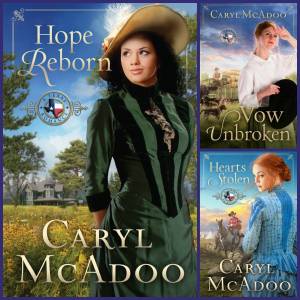
First Guest of 2015 – Welcome author Caryl McAdoo

May smiled at the Tribune’s headline, “Fillmore Says Pay Texas Off.” Even the President was thinking about the new state. (Chapter one, Hope Reborn.)

Hope reborn

Click here to buy on Amazon: Free e-book now until Thursday!

In the summer of 1850, owning slaves in the South was legal, but the issue threatened to split the northern and southern states. A big question being whether or not it should be legal in new territories in the West—including Texas? A multi-purposed bill of compromise (yes, even back then, politicians took advantage) was offered. It declared California a free state where slavery would be banned, put territorial governments in place for Utah and New Mexico, defined the border between New Mexico and Texas which had been disputed, ended slave trade in the District of Columbia, and urged approval of a new law dealing with runaway slaves.

At first, it seemed to have President Zachary Taylor’s support, but the president soon made it clear that he would do everything he could to defeat it. While Washington’s debate continued, the situation in Texas and New Mexico got worse. Texas claimed a large part of New Mexico, including the capital, Santa Fe and had even sent a representative to take control of the government there. Taylor ordered his Secretary of War to send an order to New Mexico’s military commander to use force in opposition of any attempt by Texas to seize the territory, but the secretary refused convinced that action would have the North and South at war again in no time. President Taylor’s response was to sign the order himself.

On July 4th, 1850, Taylor attended an outdoor Independence Day ceremony standing in the burning sun, then later that night, called the doctor to the White House for stomach pains. Treatments were useless, and five. days later, he died. His vice president, Millard Fillmore from New York and a Whig Party candidate, was sworn-in as president. Fillmore had opposed the congressional compromise on slavery and the western territories. Unlike Taylor, Fillmore believed a national crisis was at hand and that the compromise would help save the Union.

As president, he offered his full support to the bill. After more debate, they decided to vote on each proposal separately. The Senate and House of Representatives approved all parts of the 1850 Compromise, and President Fillmore signed them into law and ended squelched a national crisis though both northern and southern extremists remained bitter.


Hope Reborn: (Until the 15th, get the e-book Free on Amazon!)
Loss tests faith and almost eradicates expectation of any happy-ever-after. The decision to temporarily change one’s existence, no matter how successful or how hopeless, can lead to rebirth—in both cases.Books by Caryl

New York novelist May Meriwether decides a heroic Texas Ranger will make a great love interest for her new novel’s heroine. Bored to tears and loving adventure—keeps her mind off her solitude—she sets out to the Lone Star State with her constant companion and confidant Chester in tow.
Dreams for a husband and children are relegated to the recesses of her heart; the self-confessed old maid deems it’s too late. But the near-perfect widower resurrects a smidgeon of hope. Only his impenetrable, superstitious religious beliefs stand in the path to her falling head over heels, those and his love for his dead wife. Would there ever be room for her in his heart? And would he give up his fanaticism over God?
An unexpected romance surprises both. Hope is reborn in God’s unfailing love and grace. Can a life built on lies find the Way to confession, forgiveness, and true joy? In a day when the church offers the only stability on the 1850 Texas prairie, these unlikely players find one another and fall in love. But will it be enough?


Caryl M

Caryl McAdoo says she’ll never write outside the Christian genre again and has adopted “Praying my story gives God glory!” as her motto. She and husband Ron—high school sweethearts—live with two grandsons in the woods south of Clarksville, the seat of Red River County in Northeast Texas. She enjoys four-wheeling over the 916-acre McAdoo Ranch, horseback riding, and singing the new songs God gives her. For every blessing in her life, including ten children (counting in-loves) and fourteen grandsugars, Caryl credits her relationship with the Lord, and her heart’s desire is to glorify Him.
Website – http://www.CarylMcAdoo.com       (All first chapters are offered here!)

Facebook – http://www.facebook.com/CarylMcAdoo.author

Blog – http://www.CarylMcAdoo.blogspot.com

Newsletter – http://carylmcadoo.com/sign-up-to-the-caryler/       (Get FREE books for subscribing!)

Google+ – https://plus.google.com/u/0/116386927782468472563/posts

Twitter – http://www.twitter.com/CarylMcAdoo

Pinterest – http://www.pinterest.com/CarylMcAdoo


“God, the Deception.”

I hope you all had wonderful holidays! A new year begins and our countdown continues. One month to the release of “Out of the Storm” and only two more copies to give away. Congrats to Ruth B. for winning last month’s! Leave a comment here or on Facebook and it could be yours, too!

Coming Feb 3, 2015

Coming Feb 3rd!

To mark this moment we are going to take another glance at my short story, Fire in a Storm.

“He was secret police and he knew his purpose. Religion was the enemy and God, the deception. Then a glimpse of gold and silver, and the woman who wore it, threatened everything he trusted.”

As we stated in November’s blog, the main character in Fire in a storm is a member of the NKVD or “Stalin’s secret police.” As such, he has had Marxist-Leninist atheism drilled into his brain and has accepted those philosophies. Namely:

Karl_Marx

“Religion is the sigh of the oppressed creature, the heart of a heartless world, and the soul of soulless conditions. It is the opium of the people.” (Marx, K. 1976)

I must admit to hearing that often enough during the months I spent in Russia a few years ago. That last line was often ready and waiting on many an atheist’s tongue. How much more so, I imagine, in the midst of the communist regime and the heart of the persecution against religion.

Marx wrote further: “The abolition of religion as the illusory happiness of the people is required for their real happiness. The demand to give up the illusions about its condition is the demand to give up a condition that needs illusions. The criticism of religion is therefore in embryo the criticism of the value of woe, the halo of which is religion. Criticism has plucked the imaginary flowers from the chain, not so that man will wear the chain without any fantasy or consolation but so that he will shake off the chain and cull the living flower.”

Make sense?

Ok, I admit I had to read it several times, but I wanted to understand what made my character tic. It seems many Soviet leaders of the early 1900s interpreted this as: God is an illusion, therefore religion is a dome of illusion, deceiving people into false happiness and hope. How can you experience real happiness, and real life, when you are caught up in the false?

I guess I’m in real trouble because I most certainly believe in God as did many good people in the Soviet Union when this philosophy corrupted laws and led to the persecution we discussed last month. Strange how an idea about saving people from their “happy” illusions can lead to that people’s destruction… all because they decided they wanted to hang on to the beliefs that have made them happy. Leave it to a man like Lenin to militarize a philosophy.

Boris Kustodiev’s 1920 painting “Bolshevik,” depicting a revolutionary with the red flag, glaring at an Orthodox Christian church.


“Religion was the Enemy”

It’s December 3rd and our countdown to the release of “Out Of The Storm” continues! First though, I would like to announce the winner of last month’s giveaway. Thank you, Sarah M., for your comment on Facebook! We still have one more e-book and a hard copy of “Out of The Storm” to give away, so please leave a comment here or on Facebook!

Coming Feb 3, 2015

Coming Feb 3, 2015


“He was secret police and he knew his purpose. Religion was the enemy and God, the deception. Then a glimpse of gold and silver, and the woman who wore it, threatened everything he trusted.”

For anyone who missed my blog last month, Fire in a Storm‘s main character is a member of Stalin’s “secret police” or the NKVD. One of their main occupations during the 1930s was the persecution, and attempted dismantling, of religion.

demolition-annunciation-church-labor

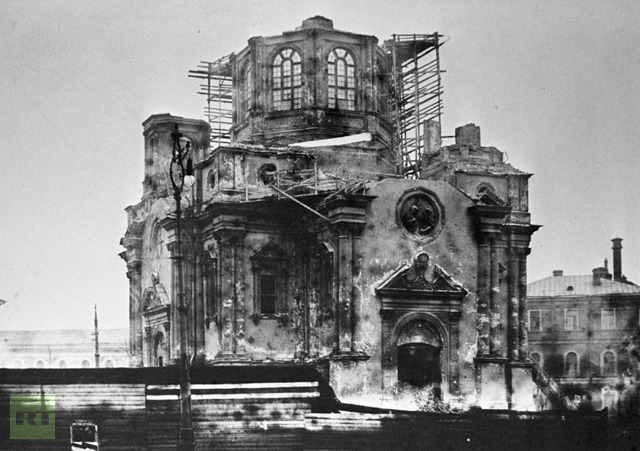
Demolition of Annunciation Church in Leningrad, 1929

Often in a very literal sense. In just over ten years the number of Russian Orthodox churches dropped from 29,584 to less than 500. Fire. Dynamite. And sometimes just sledgehammers.

churchbells

Wikipedia gives a good summary of the challenges for those clinging to their religion, and the general climate in which my story is set:

“In the late 1930s being associated with the Church was dangerous. Even a brief visit to a church could mean loss of employment and irreparable career damage, expulsion from educational establishments and even to arrest. People who wore pectoral crosses underneath their clothing could be subject to persecution. People could be arrested for such things as having an icon in their home [and] inviting a priest to perform a religious rite or service at home since the local churches were closed. Priests caught performing such rites were often imprisoned and disappeared forever. Massive numbers of believers were effectively imprisoned or executed for nothing except overtly witnessing their faith, especially if they were charismatic or of great stature and spiritual authority, because they were therefore undermining the antireligious propaganda.”

539px-Militant_atheist_Bolsheviks_firing_upon_a_Christian_Church_Procession_in_Astrakhan

 As stated by Stalin, “…to bring to completion the liquidation of the reactionary clergy in our country,” he initiated an “atheist five year plan.” 1932–1937 the hope was to “completely eliminate all religious expression in the USSR, and drive the concept of God from the Soviet Union.

Again allow me to flip back to Wikipedia to give you a glimpse at what this looked like:

Exact figures of victims is difficult to calculate due to the nature of the campaign and may never be known with certainty. During the purges of 1937 and 1938, church documents record that 168,300 Russian Orthodox clergy were arrested. Of these, over 100,000 were shot. Lower estimates claim that at least 25,000–30,000 clergy were killed in the 1930s and 1940s. When including both religious (i.e., monks and nuns) and clergy, historian Nathaniel Davis estimates that 80,000 were killed by the end of the 1930s. Alexander Yakovlev, the head of the Commission for Rehabilitating Victims of Political Repression (in the modern Russian government) has stated that the number of monks, nuns and priests killed in the purges is over 200,000. About 600 bishops of both the Orthodox and the Renovationists were killed. The number of laity killed likely greatly exceeds the number of clergy.”

Of course these don’t include all those who spend years, if not their whole lives in gulags, or concentration camps.

Not a safe time or place to live if you are true to your faith in Christ … which another one of Fire in the Storm’s main characters is. I can’t wait to share this story with you in two short months! Leave a comment here or Facebook for the chance at a free copy of this, and eleven other faith inspiring stories!