I’ve always hankered for an era not my own. Growing up, some of my favorite authors included such notables as Laura Ingalls Wilder, Louisa May Alcott, Mary Grant Bruce (an Australian author who wrote the Billabong series, about turn of the century Australian graziers—hello, I am Australian ), and of course, my favorite (perhaps because of her red-haired heroine): L. M. Montgomery. (Fresh thought: should I include a middle name for publishing purposes?)
The writing of these ladies varied, from flowery flights of imagination to pragmatic epistles of life on the land, but their skill in drawing the reader into their worlds made for many a pleasurable hour, envisaging Jo, Anne and many other spunky, imaginative girls from an era so different from 1980s suburbia.
My tastes matured, to appreciation for Jane Austen, Agatha Christie, and others who wrote evocatively about eras long gone. A more recent addition to my library is Georgette Heyer, an English novelist whose first novel, The Black Moth (written to amuse her sick brother), was published in 1921 when she was all of 19! Over the course of her life she published more than fifty books, many of them set in Georgian times.
Romance will always be a popular fiction genre, perhaps because it can be seen as a reflection of the hunger we all share for the God who is Love itself. Many historical romance novels, including those set in Regency times, tend to reflect modern (read: carnal) mindsets, with a lack of understanding of the moral sensibilities of the day. While Jane Austen could write about the times in which she lived, Georgette Heyer described settings and events that happened  over a century earlier, yet did so with such finesse she could be considered to be one of the 20th century’s pre-eminent experts on Regency customs and language. Indeed, she is considered by many to have created the Regency genre of historical fiction.
Georgette Heyer is said to have amassed literally rooms of research – no Google searches for her! – a fact which further cements my belief in her brilliance. Books on everything from 18th century signposts to snuff boxes filled her shelves, her attention to detail so precise she is reported to have bought a letter written by the Duke of Wellington to ensure she could employ his manner of speaking in the novel An Infamous Army. Commitment indeed! Her zest for period precision is reflected in how she casually refers to events, such as the reactions of onlookers to the procession of Allied Sovereigns, as mentioned in A Civil Contract. Her depth of knowledge was such she could write with astonishingly accurate recall about the mid-18th century adventures of former Jacobites in The Masqueraders, all from a grass hut in Tangayika (Tanzania)!
Whilst Georgette Heyer does not write an overtly Christian worldview as presented in, say, Lori Wick’s English Garden series, her characters still exist within the moral code of the day, with definite consequences for actions. But despite her understanding of social structure and strictures, her novels offer hope, often displaying a form of redemption for those  born into unfortunate circumstances, or with pasts they now regret, and demonstrate that love and a successful marriage does not depend merely on emotional attachment, but the daily decisions that recognize the hero or heroine’s flaws, but chooses to love and bless them anyway.
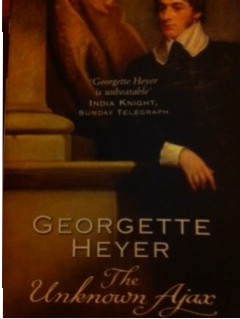
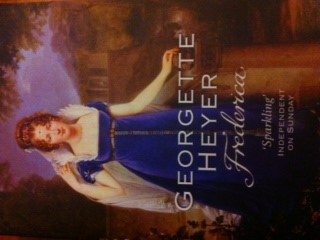
My current favorite, The Unknown Ajax, tells the story of Hugo, an unpopular heir, whose long-estranged family become reconciled to his less than desirable heritage as they learn to appreciate his kindness, his generosity, and his willingness to turn the other cheek. Another novel, Frederica, sees a selfish marquis transformed, challenged by the heroine whose concern for her family overrides thought of her future. A Civil Contract shows how the thoughtful actions of a woman, who knows she is her husband’s second choice, can see a loveless marriage of convenience lead to a state of contentment, an ordinary life, which might not be “filled with moments of exaltation”  but consisting of times, not “very romantic, but they were really much more important than grand passions or blighted loves.”
If you want a little more period detail than what is provided by Jane (Austen, of course), and would enjoy some sparkling repartee without seeing any bodices ripped, be sure to check out Georgette Heyer. Like reading Shakespeare, it may require some time to tune your ear in, but if you value historical accuracy, you will enjoy the wit and wisdom of a writer who appreciated the value of love conquering all.
 Carolyn (Ann) Miller
Carolyn Miller lives in the beautiful Southern Highlands of New South Wales, Australia, with her husband and four children. A longtime lover of romance, especially that of the Regency era, Carolyn holds a BA in English Literature, and loves drawing readers into fictional worlds that show the truth of God’s grace in our lives. Her novels have won or finaled in over a dozen contests, including the 2014 RWA ‘Touched by Love’ and 2014 ACFW Genesis contests. Carolyn is a member of American Christian Fiction Writers and My Book Therapy, and is represented by Tamela Hancock Murray of the Steve Laube Agency.
Connect with her: Website Pinterest Facebook





 Angela K Couch